

My contribution
I built the computational bridge between design intent and physical performance.
Within the MIT Design Lab collaboration, my responsibility was to develop advanced computational design systems and explicit-dynamics FEA workflows for soft footwear components, especially midsoles and outsoles.
- Moved the simulation workflow from simplified 2D studies to adaptable 3D models.
- Connected parametric geometry, simulation feedback, and rapid prototyping.
- Enabled the exploration of thousands of CMF and midsole configurations.
Development workflow
From performance requirements to product-ready directions
The system brought research, geometry generation, simulation, and prototyping into one repeatable development loop.
- 01DefineTranslate cushioning and runner requirements into measurable design targets.
- 02GenerateCreate parametric structures and controlled geometric variations.
- 03SimulateEvaluate nonlinear soft-component behavior with explicit 3D FEA.
- 04CompareReview deformation, response, and structural alternatives consistently.
- 05ExploreDevelop CMF and midsole families from the most promising directions.
- 06PrototypeMove selected concepts into physical tests and product development.
Technical development
Adaptive Dynamics · XETIC
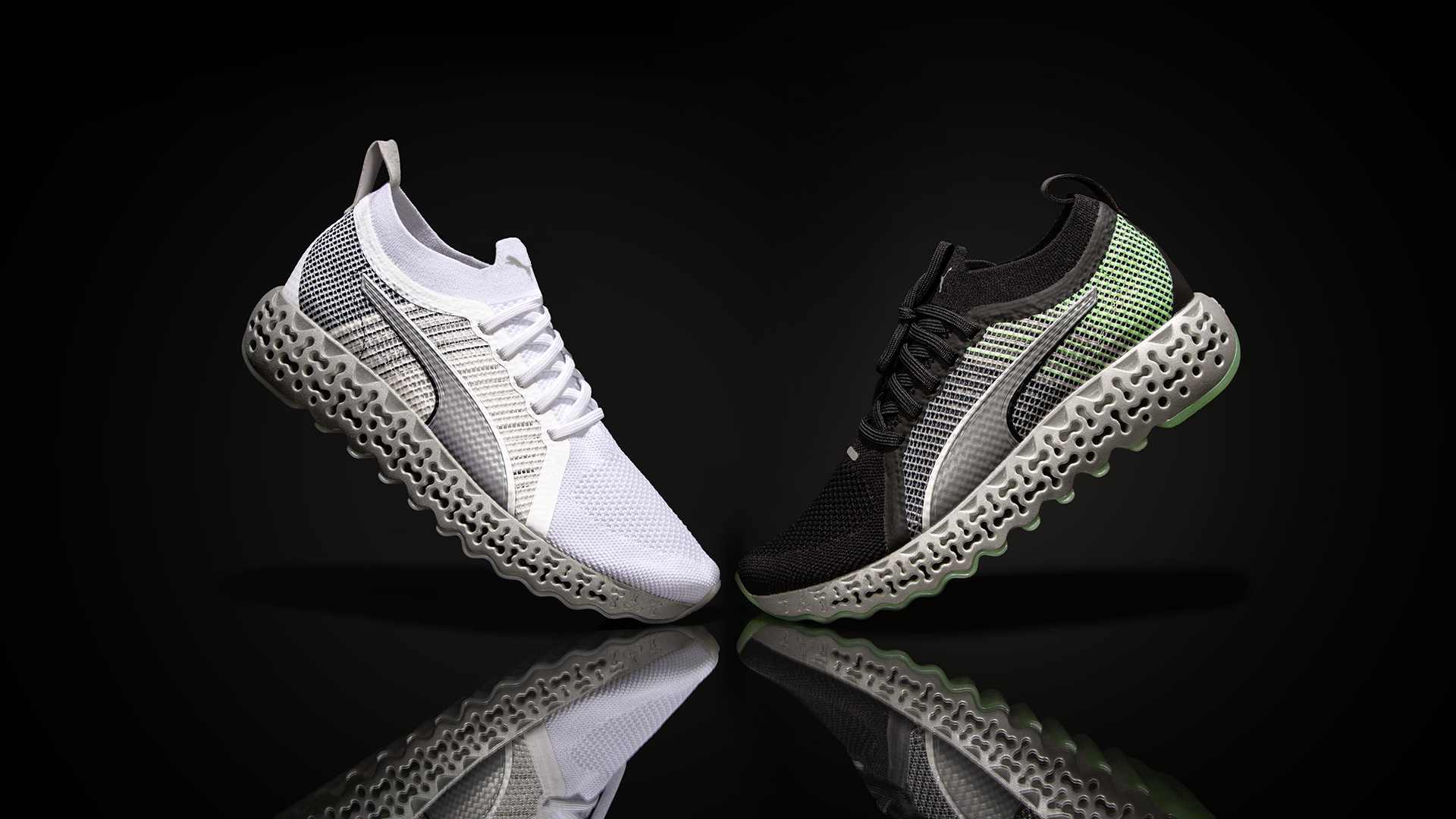
Soft midsoles and outsoles undergo large deformation, contact, and complex material response. I refined the FEA portion of the design–simulation–prototyping pipeline so the team could evaluate these behaviors in three dimensions and iterate with greater speed and confidence.
The resulting workflow did more than produce a single geometry: it created a reusable system for studying families of structures, material expressions, and product applications.
Research in motion
Simulation, prototyping, and product outcome
Research overview and the development of the adaptive cushioning concept.
The resulting technology translated computational research into a consumer product platform.
Verified product release
Research impact and public launch
PUMA’s official release identifies novel finite element analysis and parametric design as central to finding the Recurve structure used for XETIC cushioning.